


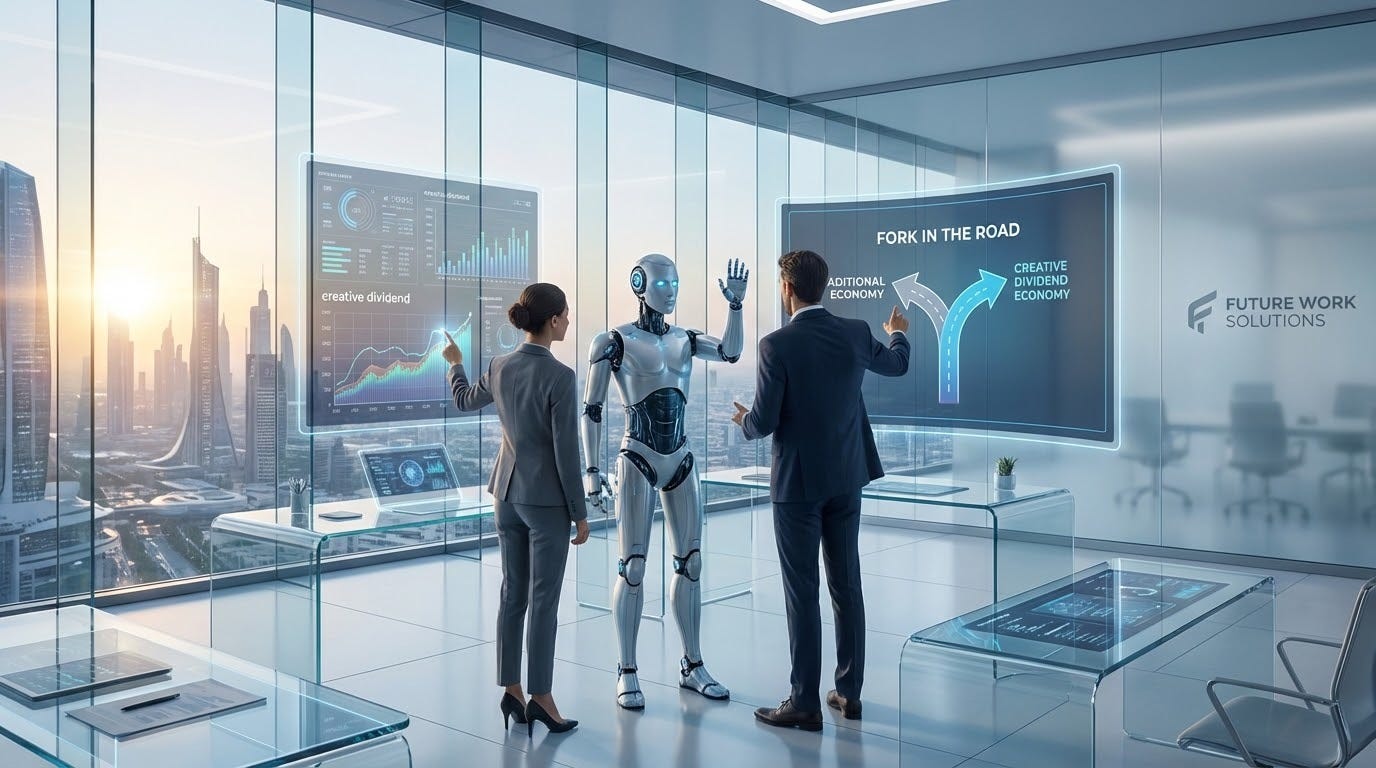
📌 THE POINT IS: The rise of AI has created a crossroads for capitalism, making the historical model of compensation tied to "toil and hours" obsolete. Business leaders must urgently redefine human value around Wisdom, Creativity, and Judgment, or face an "Implosion Cycle" where mass job displacement collapses the consumer base, ultimately bringing the entire economy down. The solution lies in "Creative Dividends" humans can bring to your company.
The Fork in the Proverbial Road
“First solve intelligence, then use intelligence to solve everything else.” — Demis Hassabis on the philosophy of DeepMind
There’s been a lot of chatter in the AI news about trillion-dollar companies, companies that will have one employee and huge margins, and companies that will pop up like weeds every time someone has an idea that they can “vibe code” into a product. But the challenge remains that many companies, especially larger ones, still expect that they’ll be able to dramatically downsize their workforce. Recent news has announced smatterings of companies like Amazon, Block, UPS, even Duolingo who have let go of contractors or employees (sometimes in the thousands) related to AI advancements.
Some of us have started to pick up our heads and ask a few questions:
Who will ensure that companies which have been around for over 100 years will last another 100 years?
Who will be the customers of these trillion-dollar companies when the population of income-earning consumers dwindles with their employment rosters?
Even the gig economy is showing signs of cracking as companies like Waymo start to advance their fleets of self-driving cars and leaders like Elon Musk start seriously pivoting manufacturing efforts to expand that technology.
We need to think about cutting a new path in the woods for our system of economics, from governments to company heads and investors, before the path most taken leads us off a cliff.
“The historical model of compensation—reward tied to toil and hours—is now economically obsolete.” — Genesis: Artificial Intelligence, Hope, and the Human Spirit
The Uncoupling: Efficiency is No Longer Value
The philosophy of DeepMind is a stark reality check for every business leader: if a problem can be solved by intelligence, AI will soon solve it at a fraction of the cost, moving the intellectual value of labor toward zero marginal cost. As Eric Schmidt, Craig Mundi and Henry Kissinger observe in Genesis; Artificial Intelligence, Hope and the Human Spirit, the historical model of compensation—reward tied to toil and hours—is now economically obsolete. AI has broken the direct link between human effort and corporate value creation. The new value must be found in uniquely human activities: Wisdom, Creativity, Judgment, and Empathy. This uncoupling of compensation from toil frees human cognitive capacity, unlocking a creative dividend that can be channeled into designing novel business models, holding continuous reimagination sessions, and pioneering entirely new markets and products.
The continued flawed assumption is that companies are looking for the cost center they can reduce via AI. The opposite question is what we should really be asking:
“Where can I increase throughput, deliver the projects that were cut last year due to funding, or recognize additional revenue streams because we can service more clients faster?”
Cost reduction will come as a function of productivity enhancements per person, but you literally cannot grow your top line if you’re focusing all of your business model changes on bottom line impacts. This is the great turning point. We can use this immense productivity to free humanity from drudgery.
“The greatest revolution of the 21st century will not be in technology, but in the definition of what it means to be human.” — Yuval Noah Harari
The Fatal Flaw: Individualism or self-wealth mindset
If the gains of AI’s productivity flow only to capital, the result is a catastrophic concentration of wealth. A small class of super-rich investors will prop up “trillion-dollar” companies that have minimal workforces and astronomical margins. However, these companies will ultimately face a terminal crisis: a collapsed consumer base. If mass job displacement eliminates the paycheck and purchasing power of the middle class, the very customers needed to buy the products and services these efficient companies generate will disappear. The cycle of layoffs leading to lost customers will cause a full-system implosion. This is why a new economic contract—one that shares the “Creative Dividend” of AI with the workforce—is not merely an ethical imperative, but an act of corporate and governmental self-preservation.
5 things you can do today in your company, large or small
Redefine Your Employee Value Proposition (EVP): Stop rewarding employees primarily for volume of execution (which AI excels at). Start rewarding them for Wisdom, Creativity, and Judgment—the human activities that are inherently better than machines.
Mandate a Creative Day: Pilot a formal 4-Day Work Week structure where the fifth paid day is ring-fenced for unrelated personal growth, deep thinking, or internal innovation “Hackathons” focused on creating entirely new markets for the company.
Implement a Core Profit Share: Design a Mutualized Profit Pool to distribute a predefined percentage of annual profits back to the workforce, ensuring that the wealth generated by your company’s AI is shared and stabilizes the broader consumer economy.
Shift L&D to EQ/Teaming: Immediately re-allocate your Learning & Development budget to training programs focused on Emotional Intelligence, Ethics, Systems Thinking, and Human-Machine Teaming, moving away from pure technical skill instruction.
Require Customer-Fronted Field Study: Embed a mandatory, recurring requirement for all senior and strategic employees to spend time on direct, ethnographic field studies with customers to discover unsolved problems and generate human-led, empathy-driven new product strategies.
Here we go…
On the one hand, this will be a very stressful time. The next few years are going to be painful as our entire society either comes together to figure out a new system that supports continued human development or falls apart due to the overwhelming pull of human greed. It’s simply no longer acceptable to continue down the path we’re on and all of the major players are sending similar signals through memorandums to / from governments and books hitting shelves every day.
I really like how this frames the pressure building in the system—especially around how technology is reshaping the foundations of value creation.
One thing that stood out to me is the implicit shift from valuing effort to valuing outcomes. For a long time, we’ve used labor and activity as proxies for value because they were measurable and consistent. That relationship is starting to break.
With AI, the gap between effort and output is widening quickly. A small amount of input can now generate disproportionate results. That forces a rethink—not just of economics broadly, but how organizations measure contribution and impact day to day.
I’ve been thinking about this in terms of a “signal-driven” model of value. Instead of focusing on how much work is done, the focus shifts to what signals are produced (predictions, insights, recommendations), how they’re activated, and whether they actually change outcomes.
In that world, value isn’t tied to time or effort—it’s tied to the quality and impact of decisions.
Feels like we’re still early in figuring out what the right metrics and models look like, but the direction of travel here makes a lot of sense.
This is exactly the conversation that everyone is avoiding. No great answers out there for how this transition work, but history says it will be messy. What will be the trigger that actually forces action? Political instability? Consumer demand collapse? To force the "AI dividend" does the AI infrastructure become a public utility?
The cultural shift required make this transition is huge. The tech has changed over the centuries, but humans are still humans. It's technically possible to make this shift. A lot depends on whether public institutions and civic engagement seriously tackle these questions while there is still meaningful room to shape the answers.