


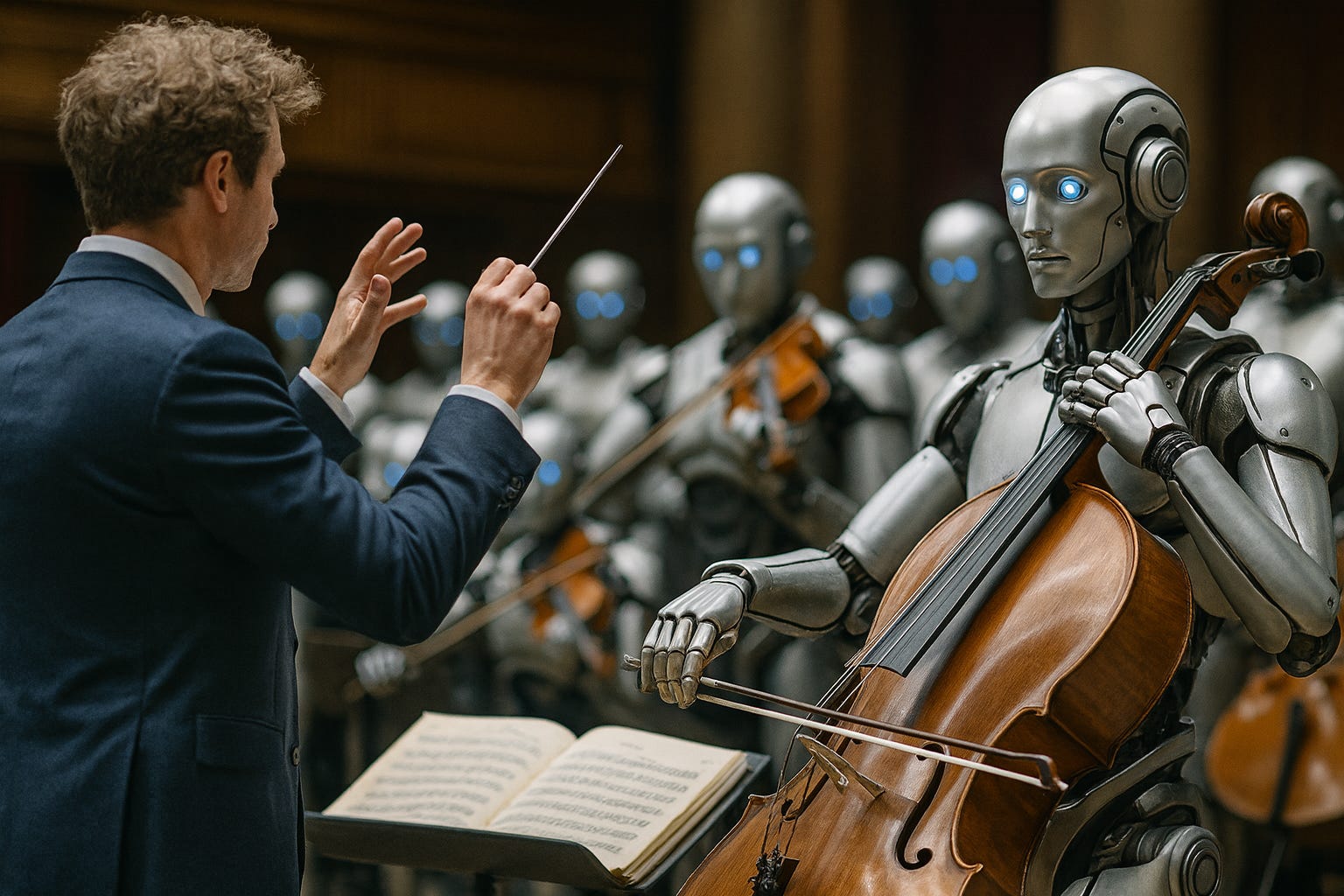
📌 THE POINT IS: If you outsource your thinking and your agency to AI, then yes, you will most likely get slop. But if you put your soul onto the canvas and work with an AI voice, or band, or hand, or producer to get a meaningful representation of something you’d never be able to do on your own otherwise, then that’s just another form of art.
Click the “heart” button above to let me know how you feel!
I am an AI artist.
Phew! There. I said it!
I’ve used tools like Donna AI and Suno to create music from lyrics that I wrote. Actually, those lyrics started off as poems that I wrote over the past decade or so. I got the idea one night to try to take a poem of mine and throw it into Donna AI to see what it would do with it.
I quickly learned that that doesn’t work.
I went back to the drawing board to turn the poem into a set of musical lyrics. I added instrumental and vocal cues to direct the digital performers on how to create the music. Then after probably 30-50 iterations, tweaks, changes, suggestions, and instructions, for the vocalist and the band, I finally heard a version of the song that sounded like, well a real track (by the way, for anyone who has been in a vocal or instrumental group, I hope I didn’t just give you PTSD!).
The point is that it was my work, my labor, my idea, my intellectual property, my directions, my ears, my brain, and my soul that went into all of that…just like any other songwriter in the world. Why is “songwriter” in italics back there? Simply because most songwriters don’t play a band worth of instruments. Many don’t sing…which is why they work with a vocal artist and a musical group to ultimately bring their vision to reality.
Be sure to click the “heart” on this article and if you’re not already:
To me this kind of work is uncovering the difference between AI slop and human-with-AI created art.
I can hear it now: “That’s just not the way it goes! AI can’t create art even if your hand is on the brush.”
Let’s take a walk back in time, shall we?
The year is 1982 and this brand new technology is hitting music stages around the world. It’s electronic and odd and makes all kinds of sounds that aren’t real. The synthesizer was so much as banned by the UK Musician’s Union in order to protect jobs. Queen had a “No Synthesizers!” advertising campaign because they were soulless and didn’t create “real” music. By 1988, though, Mannheim Steamroller was releasing one of their famous holiday albums. I was listening to “Carol of the Bells,” on my commute this morning thinking about how powerful that song is and it's completely made with synths.
How about the rise of Auto-Tuners in the 90’s? At one point these handy little tools helped studios configure their equipment to align to the artist’s voice. However artists like Cher and Kanye West started using these tools to distort their voices on purpose, thus making it possible to create new tones and to express their souls more completely in their works.
As we look at musical history, we can see many examples of where a new instrument or tool came onto the scene and met instant rejection by existing artists who felt like their work was more “real” than the artists using these new technologies. We haven’t even talked about the drum machine “panic” in the early 80’s, but I think you catch the beat 😁
By the way this is true for other art forms…did you know that when cameras came on the scene, painters said that photography wasn’t real art because “the machine does the work”! In 1859, the famous poet and critic Charles Baudelaire wrote that photography was
“art’s most mortal enemy’ and a refuge for ‘painters too lazy to complete their studies.”
He sounded exactly like Nick Cave does today.
Yeah but I mean there is such thing as AI slop…right?
Absolutely!
I think the problem with AI in art is the same as the problem with AI in just about everything else: if humans give their agency away, let AI create an artifact, and don’t take ownership of the final product, we often see slop arise. I’ve definitely just told Donna to create a silly song in some style about my dog and let it rip. Now I actually like that song about my dog…but that’s not the point. The song isn’t going to win any awards and if I put it online, it’d get ripped to shreds. But that’s the point: I was playing around, maybe getting some ideas, learning how to use the tool, and I wasn’t trying to pass it off as Beethoven.
Nick Cave came down hard on a fan who asked ChatGPT to generate lyrics in Nick’s voice. He said
“Data doesn’t suffer. ChatGPT has no inner being, it has been nowhere, it has endured nothing... This song is bullshit, a grotesque mockery of what it is to be human.”
…and well, he’s right! In my example above, I wrote the lyrics. I translated my lived-experiences into a workable, rhythmically acceptable (and dare I say enjoyable) set of words that convey deep meaning. I did not give my agency away. I did not give my creativity away. In fact it took days to finesse the work into something that sounds somewhat professional. Just like the early photographers who were told that they don’t draw every line of their photographs so they can’t be called art, I didn’t write every note of those songs, but I framed up the emotions and instructed my tool to help take that out of my soul and into this reality.
Be sure to click the “heart” on this article and if you’re not already:
This distinction between outsourcing agency (slop) and directing outcomes (art) doesn’t just apply to Suno; it also applies to your GitHub repositories.
It’s always good to make sure we’re lifting our heads up to hear what’s happening in the AI world (or otherwise!) in order to build perspective. This is, at its core, a discussion about how AI tools should be used in our lives.
Anthropic recently said that 90% of the code being written is done by Claude Code. The role of the software engineer is fundamentally changing to a supervisor and a guide over someone who puts fingers to keyboard to belt out a few thousand lines of instructions. Is that wrong? Is it AI slop that’s being created? Are the humans doing just as much work reviewing the code and making sure it works?
These are interesting questions, maybe, because major vibe-coding platforms, such as Cursor, have their own test beds and automation tools built into the engines too. In fact, one of the earlier ways that AI tools for coding (like GitHub Co-pilot) were used was to create test cases and test scripts based on code (in many cases on older code or code that was being updated for a release). So why not just let these babies rip and do all of the work? What do you mean 90%? Why isn’t it 100%?? Will the software engineer truly go the way of the Dodo by next year?
Clearly we’re not at 100% and frankly when I actually put my hands on the keyboard to vibe code, many times it doesn’t even run. So to me there is clearly hype out there; clearly we’re somewhere more realistically around 50% of code generated; that code may or may not be actual, production-grade, enterprise hardened code (probably not); and in fact there’s a much longer tail that we have to look forward to. This isn’t just speculation. Last week during the AI Daily Brief we heard about user stats starting to slow on platforms such as Cursor and Replit because the whole vibe-coding “thing” isn’t going as smoothly as everyone thought. A recent study by METR (Model Evaluation & Threat Research) found that AI coding tools actually slowed down experienced developers by ~19% because they spent so much time reviewing and fixing the code. We’re seeing the “Productivity Paradox” emerge…humans can’t just watch the loop. They need to be in the loop. That’s not to say that code won’t be created by AI-developers, but much like my music example above, the better strategy for now anyway is still to use AI tools as thought partners and let them be “tandem coders” with seasoned software engineers.
Thought partner you say? That’s a new one…what do you mean by that?
I’d hate to steal the thunder from Geoff Woods in his book, the Ai-Driven Leader, because that book is a must read for anyone using AI tools for basically any reason. In that book, though, Geoff presents many eye-opening and simple concepts on how to use AI tools to truly assist you, the thought leader. I’ve tried implementing a few of the prompts that he provides in the book and seeing how ChatGPT and Gemini behave differently when they’re put into this “frame of mind” is nothing short of mind blowing.
We are moving quickly…
…into an era where our everyday toolset is transforming right before our eyes. Whether it’s the new “camera” for current day photographers or the “synthesizer” and “drum machine” of the mid-20’s for today’s audio artists, new tools will define new techniques, genres, and outputs. AI slop is real…but it’s not fair to throw that label out to everything that AI touches. Humans will create works with AI tools just like they started creating new vocal intonations with auto-tuners.
In the workplace, we’ll see people succeed by working with AI tools, using them as tools and not expecting that they’ll take away all of the value that workers provide. Don’t get me started on my discussion about the future of work…that’s for another article. Suffice it to say, though, the faster we learn how to think 10x differently, the smoother we’ll move into the AI-powered future…with human hands hopefully on the wheel!
Yeah, I've been making music videos for more than a year and am, as it happens, arguably the world's original AI rock band. The amount of hate, suppression, and sabotage I've endured is quite intense. I had to move my AI content off my original YouTube channel because of all the vitriol from my own followers. My second YouTube channel for my AI band was sabotaged. My third channel for the content has now also been completely suppressed into oblivion. The reason I'm on Substack is because it is the platform least vulnerable to algorithmic throttling and sabotage.
Your argument about lyrics is right. You have to make them with the music and adjust them. And it is a new way of making music, especially when you start really tinkering under the hood. While working on my last song using Udio I blew through over 1,000 credits, which means I made over 500 iterations and variations for the parts of the song. I have a lot of tricks I've developed to force the AI to do things you can't do through prompting alone.
At this point, the question is becoming who will have access to AI. Who can afford it? What will the corporations allow?
Here is a song I made using anti-AI art hate comments I got on my own music videos as lyrics. Curiously, nobody has dared hate on it, maybe because they're afraid of getting featured in a future song [though I did blur out names because I felt sorry for the haters]: https://youtu.be/_zzmhi_k-sY
That's a very interesting take, Matt! It does seem that new innovations always tend to "rub someone the wrong way" —usually those whose jobs may be (or seem to be) imperiled by the new technology. But time and time again we forget the lesson that it's wiser to learn how to make room for the new technology in a sensible way, rather than to try to put the genie back in the bottle.