


Click the “Heart” icon and/or Restack / Share to show me that you vibe with this article! Thanks!
📌 THE POINT IS: entry-level jobs won't disappear…a range of experiences will continue to be crucial in any company. But what the entry-level associates do will be 3-5 years more advanced than what they are today. AI will empower a broadening of products offered and work done by people as we get great at identifying human jobs vs. AI jobs.
In my role as the Head of Enterprise Data, I'm involved with developing our plans to build upskilling programs for everyone from entry-level to experienced associates. The more I discuss the role of AI at companies, the more I'm seeing that although today's philosophy and assumptions are that the entry-level roles are being targeted, it's really the middle-manager role that will probably be phased out before that happens.
“Junior staff might have spent their early careers doing routine work... Many of those tasks are now handled quickly by AI tools.” — Mindset AI Podcast
Let's take a closer look: 3 year horizon
Right now companies are looking at AI in terms of traditional ROI with the “R" really targeted to increasing efficiency and thus reducing headcount. The problem with that relates to Jevons Paradox. Companies who “do it right" will find that maybe they tighten their belt with some hiring, but really the “R" will be in expanding their market or market impact through new products, offerings, or capabilities.
So what about entry-level talent? Stanford research shows a 13–16% decline in entry-level roles in AI-exposed fields. Meanwhile in the UK, graduate roles in the Tech sector were cut by 46% from 2023-2024. The impact of these cuts on companies who aren't training new entrants to the workforce are going to explode as we think about the “aging workforce” problem that's already starting to breach the surface. Baby Boomers have largely been retiring over the past several years with many more soon to come. Early Gen Xers are also starting to retire now. Very quickly over the next decade or two we'll see most of the leadership teams at today's top companies exit the workforce. While that could result in a “pushing up" of the current workforce today, not having anyone to support the operations of a company will clearly lead to disaster.
We need to be preparing today to maximize both AI and human workers
The reckoning that we all have to have as leaders now is that there are “human" roles and there are “AI" roles. The sooner we can draw a line in the sand at our companies the better. Here's an example: recently I was shopping at the NFL Pro Shop at Bank of America Stadium in Charlotte. There were people on the floor helping customers find sizes, reach high-up merchandise, and answer questions. When I got to the checkout line, there was one person at the beginning of the line handing out clear bags and instructing customers to put their items into the bag in order to checkout. That sounded backwards, but when I got to an open register, the computer told me to put the bag into a basket. The items were automatically scanned using computer vision and the total appeared on the screen. With a tap of my digital wallet, I walked out having experienced the most seamless checkout process ever. The lesson was clear: humans were on the floor doing human work (sales, sizes), while AI handled the transactional work. It maximized the ‘R’ on their ‘I’ without turning the store into a soulless vending machine.
Even if that's true, what about the longer term impact?
Picture this, your company, 2035…a new batch of marketing freshers are arriving. In the old days (2025…), a brand new marketing associate may spend a lot of time doing data input, web searches, maintaining mailing lists, and other menial tasks that are “important to learn the ropes". It could take 3-5 years for that junior employee to get exposed to more higher-order and higher-impact responsibilities such as performing in-depth market analyses and interacting with customer data through surveys or product research. In that timeframe, by the way, companies lose sometimes up to 80% of a hiring class to other companies who may be willing to pay more just to fill their rosters.
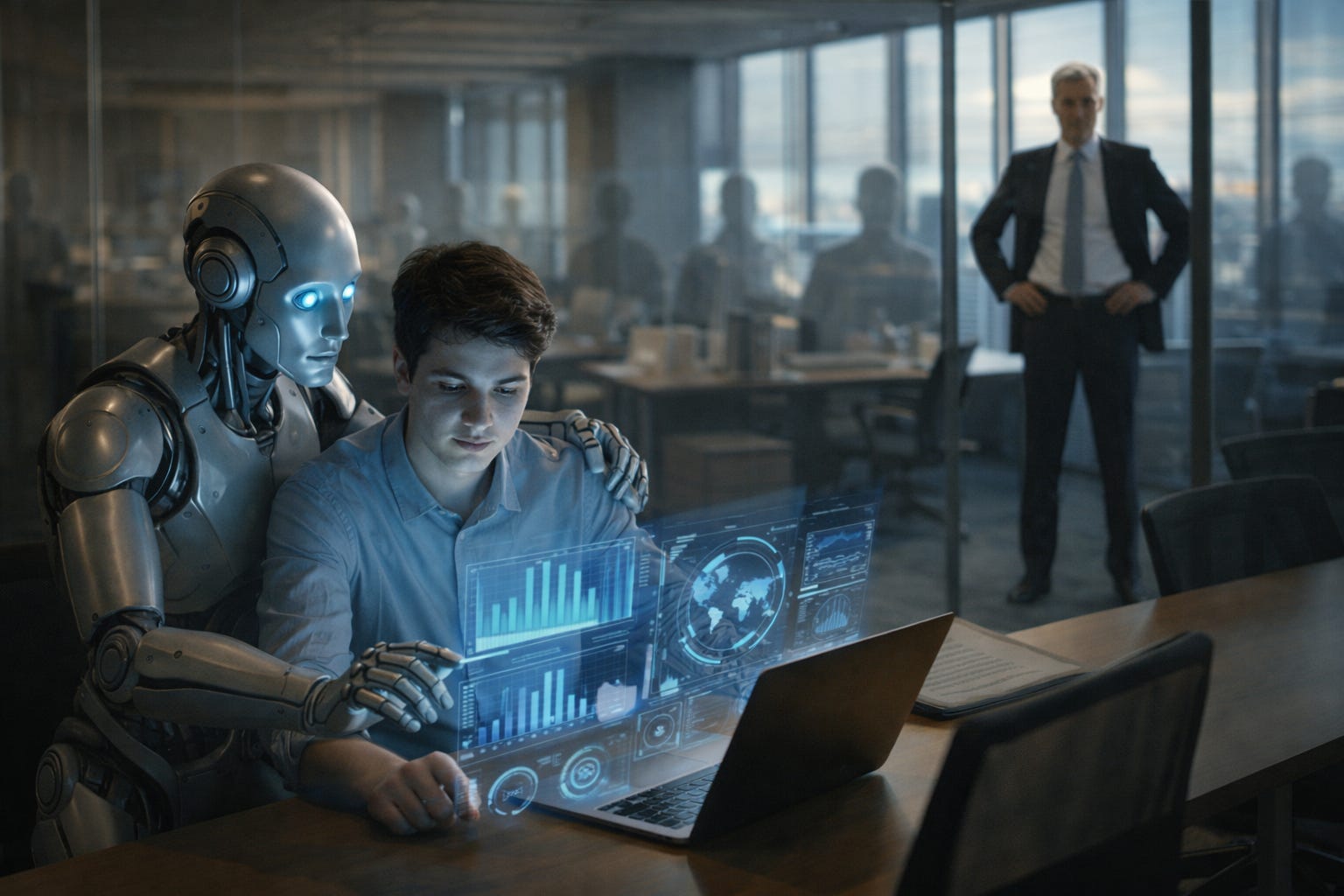
In 2035 brand new marketing associate will start with an AI buddy that onboards them, trains them, and gets them familiar with the tools and information needed to be effective. The AI will do research, data entry, and mailing list management. The first year associates will be empowered by AI to be product owners, product managers, product analysts, brand-value contributors, or design consultants. Jobs that would have taken years to break into will now be part of the entry-level expectations because AI will take care of those menial tasks that don't really “require” humans.
It's important to hang onto the concept that “humans" should continue to be the “thought leaders” with AI supercharging them as “thought partners".
“By 2026, 20% of organizations will flatten their structures, removing over half of middle management positions.” — Gartner
With flatter organizations and more associates working on value-added work, relying on AI to handle the tasks that aren't as high-impact, senior leaders will need to be able to be thought leaders that can also direct much larger teams of humans and AI. The thought leader skillset will be crucial because AI associates will bring edge cases, exceptions, and more thought-worthy scenarios to the human's attention. Meanwhile, there will still need to be an array of experience levels across these teams so that humans can direct less-experienced teammates and ultimately guide an ever-widening swath of new products, services, and projects that just weren't able to get off the ground with much more limited, expensive human resources in the past.
This sounds lovely but you still need less people which means higher unemployment
A couple parting thoughts to chew on with this one. First, global birthrates have halved in the last 70 years, meaning the future workforce will naturally shrink. This makes AI supplementation a necessity, not just a choice. It may end up being great timing that we're walking into a situation where AI can supplement workforces considering there will be much smaller ones in the future as this trend continues.
But there's another thread to pull here: as companies ultimately become a projected 5-10x more profitable per employee, we may start to see the return of defined benefits plans such as pensions return to the stage. The government and social security will not be able to handle the impact from people retiring or simply not getting jobs as the AI workforce expands thus pushing some of the responsibility back to companies. As companies expand, though, too, they will be just as invested in making sure that people have money to spend on the products they develop so that the companies can be profitable. It does seem like a bit of a ouroboros, however I like to think of it as a virtuous cycle instead of a destructive one.
“Artificial intelligence has the potential to help facilitate more sustainable pensions... unlocking more ways for people to remain engaged in the workforce for longer.” — Mercer
The other reason that companies will end up taking on a role in keeping people funded is that with a shrinking workforce, just imagine how valuable those humans will end up becoming! Competition often drives creative compensation and retention packages to be created and how attractive will it be for new associates to know that they'll be secure later in life when they ultimately go out to enjoy their golden years.
One thing is for sure: the future is coming
There's a LOT we don't know about how AI in the workplace will continue to shape our society. One thing is for sure: it's coming. Companies who figure out the optimum roles, boundaries, and accelerators for humans will win the long race, while others will see a short-term boom and a long-term flop.