



In January, I argued that AI could hollow out traditional middle-management work before it eliminated entry-level roles. My point was not that interns would disappear. It was that entry-level associates could do work that is three to five years more advanced than they do today.

📌 THE POINT IS: AI will not eliminate the need to develop early-career talent. It will make intentional apprenticeship more important. As AI takes on routine work, leaders must create structured opportunities for young professionals to build judgment, challenge outputs, and learn alongside experienced people. The good news: your existing leadership programs may just need to be adapted to the AI era!
I still believe that thesis, but it raises a more important leadership question: If AI accelerates the work, how do we accelerate the development, creativity and judgment of the people doing it?
The early evidence is complicated. A recent Strada Education Foundation survey found that 42% of employers say AI has increased analytical and judgment-based responsibilities in entry-level roles. At the same time, 41% say it has reduced foundational, skill-building tasks.
That should not lead leaders to conclude that early-career talent is less necessary. It should lead us to rebuild the apprenticeship.
I saw the value of this firsthand while leading GE’s premier entry-level technology leadership program.
I set global standards for internships and leadership-program hiring. Degrees and hard skills mattered, and we used the GPA as a baseline screen. But the real signal of potential often came from internships, projects, app development, hardware experience, and the simple evidence that someone was a passionate young technologist.
Then we hired them and spent two years developing them the GE way: our methods, our curriculum, our technology, and our leadership expectations. The model worked because it did more than teach technical skills. It built context, judgment, relationships, and a shared standard for what good looked like.
Five years from now, that kind of program won’t need two full years.
AI could help a new hire learn faster, contribute sooner, and practice against more scenarios. The entry criteria may change too. A candidate’s ability to use AI well, build with it, and question its output may matter more than traditional credentials. Instead of teaching new leadership program members how to manage people via contractors, we’ll be teaching them to be thought leaders for a group of AI agents. They’ll need to be the creative spark, the question asker, and the decision maker that steers their own personal AI team.
The core concept will be stronger than ever: organizations cannot outsource the development of their future leaders to universities, boot camps, or chatbots.
I call the leadership response the RISE framework.
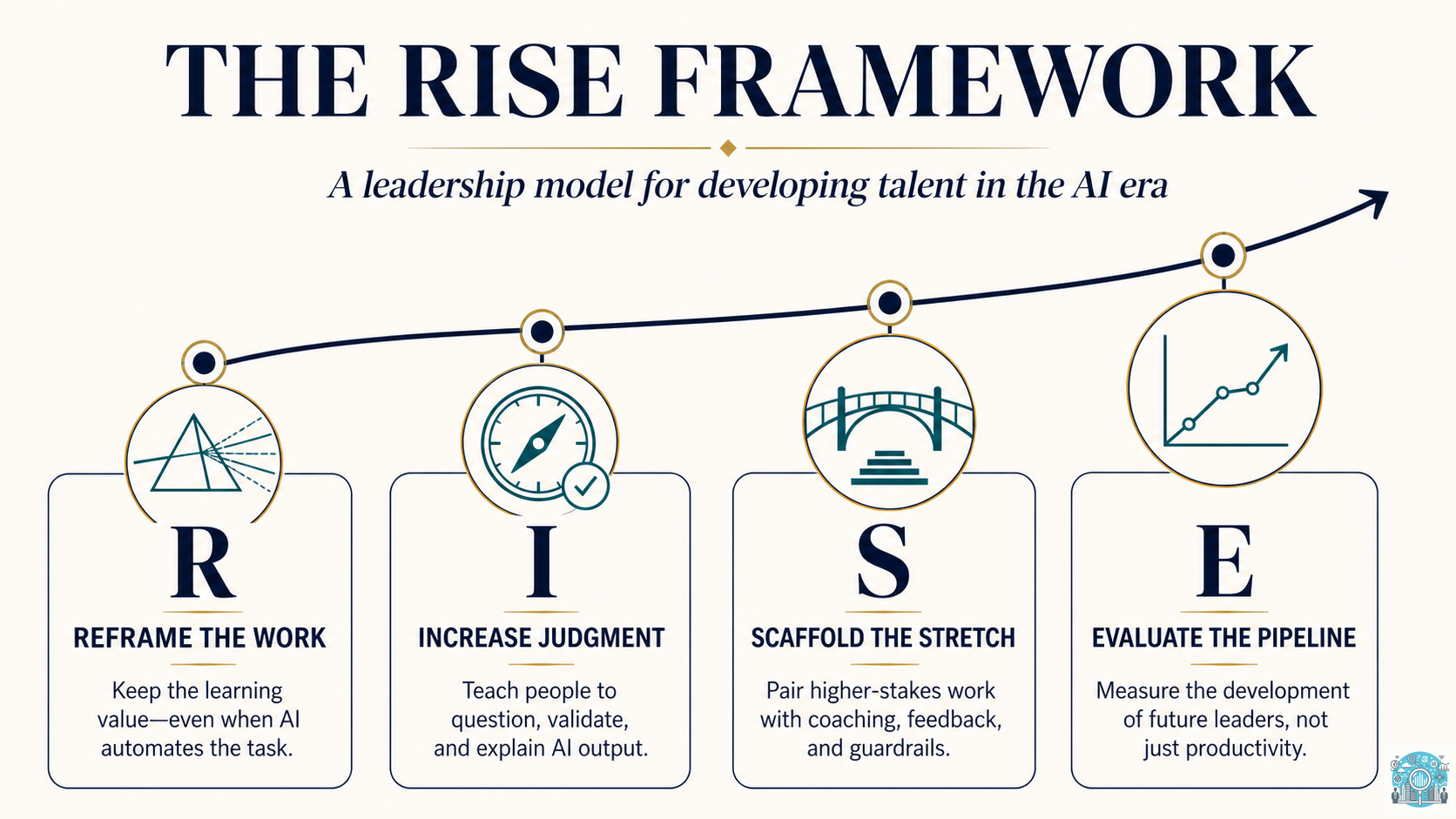
Reframe the work
Do not evaluate entry-level tasks only by whether AI can automate them. Ask what each task teaches: customer context, technical intuition, decision-making, or how the business actually works. Some routine work can disappear. The learning value cannot.
Increase judgment
AI can produce a draft, an analysis, or a recommendation. Early-career employees should know when to push back, when to push further, how to validate or question what doesn’t make sense, and how to steer the overall activity. Just like in the early days of the Internet when we taught new associates how to validate what they found on websites, we’ll need to teach them to investigate, validate, and explain AI answers.
Scaffold the stretch
This is a fun way of saying to make sure you remember that new associates will need stretch assignments to grow, but it’s still the leader’s responsibility to set the guardrails and give direction and feedback. AI can shorten the learning curve, but it cannot replace coaching.
Evaluate the pipeline
Measure more than productivity and headcount. Track internship quality, junior hiring, mentoring capacity, promotion velocity, and how long it takes to build independently trusted professionals. A company that saves money by eliminating learning opportunities is limiting its own growth potential and longevity.
The winners of the AI era will not be the companies that hire the fewest young people.
They will be the ones that turn motivated young technologists into capable leaders faster and more intentionally than anyone else. Those that don’t will face a different outcome. They may build teams that look highly productive on paper but are fragile in practice. They may be capable of generating output, yet uncertain about what outcomes will drive their companies forward.
In a world where AI can generate answers instantly, the scarce skill is no longer access to information. It is judgment, creativity, context, and leadership. Those are not learned by skipping the apprenticeship. They are learned by reinventing it.
Like and Share this newsletter to spread the word about practical data and AI strategies for executive leaders!